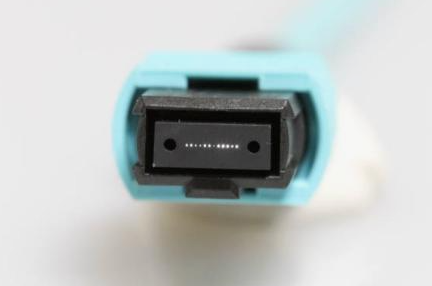
An MPO connector (Multi-fiber Push On connector) is a high-density fiber optic connector designed to connect multiple optical fibers in a single interface. It is widely used in modern high-speed networks such as data centers, telecommunications systems, and cloud infrastructure where space efficiency and fast deployment are essential. MPO connectors simplify fiber management by combining multiple fibers into one compact connector system.
What Is an MPO Connector?
An MPO connector is a multi-fiber connector that can hold and align multiple optical fibers commonly 8, 12, 16, or 24 fibers within a single ferrule. Instead of connecting individual fibers one by one, MPO technology enables simultaneous connection of multiple fibers.
This makes it ideal for high-density environments where fast installation and high bandwidth are required.
How MPO Connectors Work
MPO connectors transmit data using light signals through precisely aligned optical fibers. Each fiber inside the connector carries an independent data stream.
The process includes:
- Fibers are arranged in a precise row inside the ferrule
- Alignment pins ensure accurate positioning
- Connectors are pushed together for secure mating
- Light signals pass through aligned fiber cores
- Data is transmitted simultaneously across multiple channels
This parallel transmission allows extremely high data capacity.
Structure of an MPO Connector
Ferrule
The ferrule holds multiple fibers in precise alignment for accurate signal transmission.
Housing
The outer shell protects internal components and provides durability.
Alignment Pins
These ensure correct positioning between male and female connectors.
Push-Pull Mechanism
Allows quick connection and disconnection without complex tools.
Types of MPO Connectors
Male MPO Connector
Contains alignment pins to ensure precise fiber alignment.
Female MPO Connector
Does not have pins and relies on male connectors for alignment.
Single-Mode MPO Connector
Used for long-distance communication with low signal loss.
Multi-Mode MPO Connector
Used for short-distance, high-speed connections within data centers.
MPO Connector Polarity Types
Type A (Straight Through)
Fibers are connected in a direct one-to-one mapping.
Type B (Reverse)
Fibers are reversed to maintain correct signal orientation.
Type C (Pairwise Flip)
Adjacent fibers are swapped for specific network configurations.
Proper polarity ensures correct data transmission.
Key Benefits of MPO Connectors
High-Density Connectivity
Multiple fibers are connected in a single compact interface.
Faster Installation
Reduces installation time compared to individual fiber connections.
High Bandwidth Support
Enables large-scale data transmission for modern networks.
Scalability
Easily supports network expansion in data centers and telecom systems.
Efficient Cable Management
Reduces clutter and improves airflow in server environments.
Applications of MPO Connectors
Data Centers
MPO connectors are widely used to connect servers, switches, and storage systems efficiently.
Telecommunications
They form the backbone of high-speed telecom infrastructure.
Cloud Computing
Cloud providers use MPO technology to manage large-scale data traffic.
Enterprise Networks
Businesses rely on MPO connectors for internal high-speed communication systems.
5G Networks
Supports high-capacity backhaul and next-generation mobile infrastructure.
Installation and Maintenance
Installation Process
- Inspect connector cleanliness
- Align MPO connectors using guide pins
- Connect using push-pull mechanism
- Test signal strength and continuity
Maintenance Tips
- Keep connectors dust-free
- Use protective caps when not in use
- Avoid bending or stressing cables
- Clean end faces regularly
Proper handling ensures long-term performance.
Challenges of MPO Connectors
Despite their advantages, MPO connectors have some challenges:
- Requires precise alignment
- Sensitive to dust and contamination
- Higher cost than standard connectors
- Needs skilled installation
However, their efficiency makes them essential in modern networks.
Future of MPO Connector Technology
As data demand grows, MPO technology continues to evolve:
- Higher fiber counts per connector
- Improved alignment accuracy
- Faster deployment solutions
- Enhanced durability and performance
These improvements support the expansion of high-speed global networks.
Conclusion
An MPO connector is a critical component in modern fiber optic infrastructure, enabling high-density, high-speed, and scalable connectivity. It plays a key role in data centers, telecom systems, and cloud networks. As digital communication continues to grow, MPO connectors will remain essential for supporting efficient and high-performance global connectivity.