HIPAA Risk Assessment in Shoreline: How to Identify Security Gaps and Protect Patient Data
Patient information is one of the most sensitive types of data a healthcare organization manages. From medical histories and prescriptions to insurance details and billing records, every piece of protected health information (PHI) must be handled carefully. A single security gap can expose confidential records, interrupt daily operations, and create serious compliance challenges.
Healthcare providers in Shoreline, Washington, face a growing need to protect electronic health records, secure connected devices, and manage access to patient information. A HIPAA Risk Assessment in Shoreline helps healthcare organizations identify potential security weaknesses, understand their risks, and develop practical safeguards to protect sensitive information.
Whether you operate a private medical practice, dental office, specialty clinic, or healthcare facility, understanding how risk assessments work can help you build a more secure environment for patients and staff.
What Is a HIPAA Risk Assessment?
A HIPAA risk assessment is a structured process for identifying potential threats and vulnerabilities that could affect the confidentiality, integrity, and availability of protected health information.
The Health Insurance Portability and Accountability Act (HIPAA) includes requirements under its Security Rule for covered entities and business associates to assess risks to electronic protected health information (ePHI).
The assessment examines how patient information is created, stored, accessed, transmitted, and maintained across an organization's systems and workflows.
It typically evaluates:
-
Electronic health record systems and medical software
-
Computers, laptops, tablets, and mobile devices
-
Cloud storage and online healthcare applications
-
Employee access permissions and authentication methods
-
Network security and wireless connections
-
Data backups and disaster recovery procedures
-
Third-party vendors that handle patient information
-
Policies for managing and reporting security incidents
The goal is not simply to identify technical problems. It is to understand how information could be exposed, altered, lost, or made unavailable and determine which safeguards are needed to reduce those risks.
Why Healthcare Practices in Shoreline Need Regular Risk Assessments
Healthcare organizations rely on technology to deliver care, manage appointments, communicate with patients, and process payments. While these systems improve efficiency, they also create opportunities for unauthorized access and data exposure.
A risk assessment helps providers understand where their security measures may be insufficient before a problem occurs.
Protecting Electronic Health Records
Electronic health records contain highly sensitive information, including diagnoses, treatment plans, medications, and personal details.
If an unauthorized person gains access to these records, patients may face privacy risks, while the healthcare organization may experience operational disruption and compliance concerns.
A risk assessment reviews how records are protected and whether access controls, encryption, authentication, and monitoring practices are appropriate for the organization's environment.
Reducing the Risk of Ransomware and Cyberattacks
Ransomware can prevent healthcare staff from accessing essential systems and may expose sensitive patient information.
A risk assessment examines potential weaknesses such as outdated software, insecure remote access, insufficient backup procedures, and poorly protected network devices.
Identifying these gaps allows organizations to prioritize security improvements, including stronger authentication, secure backups, timely software updates, and incident response planning.
Supporting HIPAA Security Rule Compliance
HIPAA requires covered entities and business associates to implement appropriate administrative, physical, and technical safeguards for electronic protected health information.
A documented risk analysis is a key part of the Security Rule's administrative safeguards.
Conducting an assessment helps an organization understand its security risks and determine whether existing policies and controls address those risks. However, completing a risk assessment alone does not establish full HIPAA compliance.
Common Security Risks That Can Affect Patient Data
Understanding common vulnerabilities helps healthcare organizations recognize where additional protection may be necessary.
Weak Passwords and Unauthorized Access
Shared accounts, weak passwords, and excessive user permissions can make it easier for unauthorized individuals to access confidential records.
Healthcare organizations should use unique user accounts, appropriate access restrictions, and multifactor authentication where suitable.
Access should be based on each employee's job responsibilities, with permissions reviewed regularly.
Outdated Software and Unsecured Devices
Older operating systems, unsupported applications, and unpatched devices may contain security weaknesses that attackers can exploit.
A risk assessment should identify devices and applications that handle patient information and evaluate whether they receive appropriate security updates.
Organizations should also establish procedures for managing lost devices, securing mobile equipment, and removing access when employees leave.
Phishing and Employee Errors
Phishing emails may trick employees into sharing login credentials, opening malicious attachments, or visiting fraudulent websites.
Accidental disclosure can also happen when staff send information to the wrong recipient or use an unauthorized file-sharing service.
Regular security awareness training, clear communication procedures, and practical reporting processes can help reduce these risks.
Third-Party Vendor Vulnerabilities
Healthcare practices often depend on billing companies, cloud service providers, IT support teams, and other vendors.
If a vendor has access to protected health information, its security practices may affect the healthcare organization's overall risk.
Risk assessments should identify relevant third parties, review their access to patient data, and evaluate whether appropriate business associate agreements and security controls are in place.
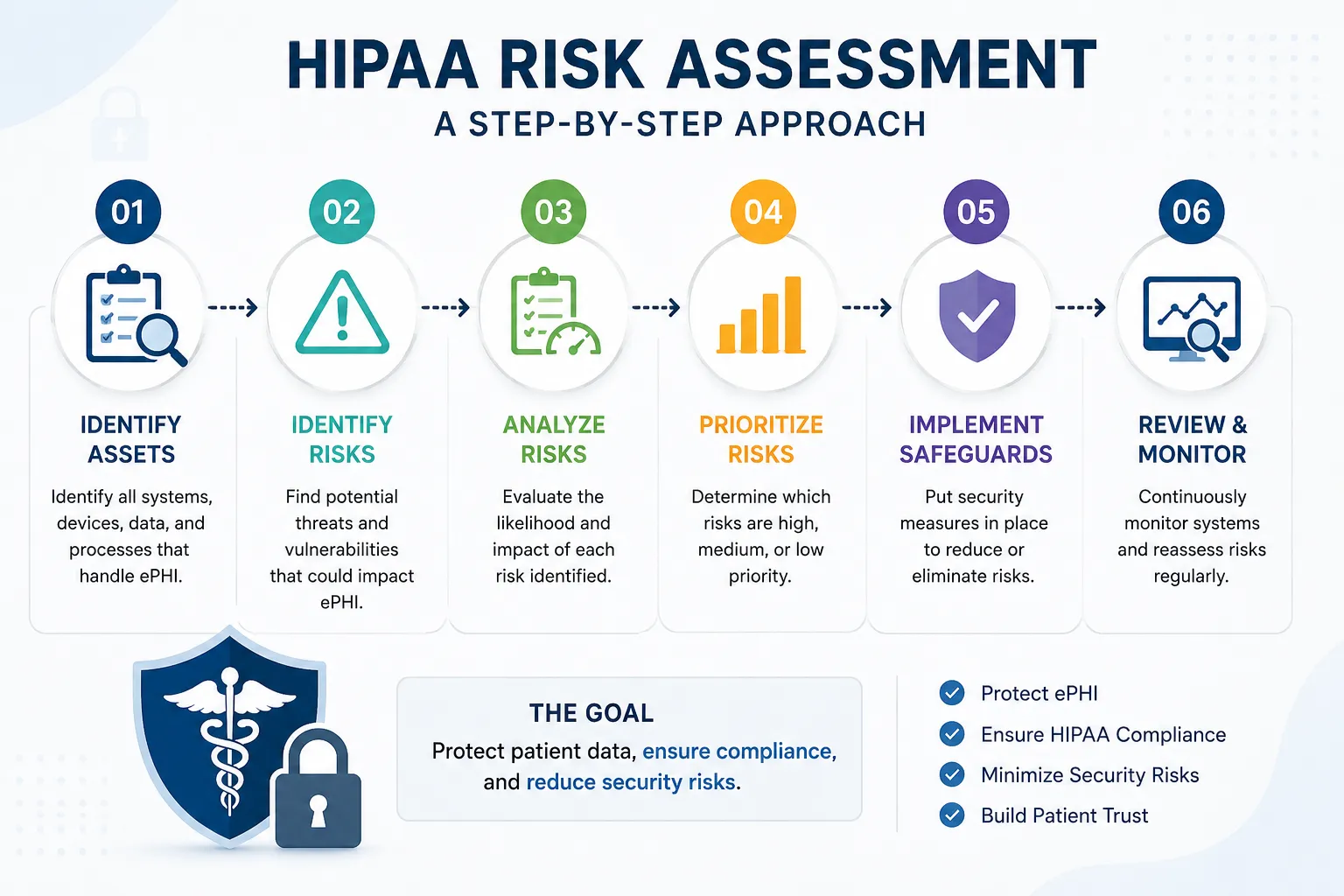
How a HIPAA Risk Assessment Works
A structured assessment gives healthcare organizations a clearer understanding of their current security posture and the steps needed to improve it.
Step 1: Identify Where Patient Information Is Stored
The first step is to understand where protected health information exists throughout the organization.
This includes electronic health records, billing platforms, email systems, connected medical devices, physical workstations, and cloud applications.
Healthcare providers should also identify how information moves between employees, departments, business associates, and external systems.
A complete inventory helps prevent important systems or data locations from being overlooked.
Step 2: Identify Potential Threats and Vulnerabilities
The next step is to examine what could compromise the security of patient information.
Potential threats include cyberattacks, unauthorized access, employee mistakes, equipment failures, natural disasters, and improper disposal of sensitive records.
Vulnerabilities may involve weak access controls, missing security updates, insufficient staff training, or inadequate backup procedures.
Understanding both threats and vulnerabilities helps organizations determine how security incidents could occur.
Step 3: Evaluate Existing Security Safeguards
An assessment reviews the administrative, physical, and technical controls already in place.
Administrative safeguards include security policies, workforce training, assigned responsibilities, and incident response procedures.
Physical safeguards involve protecting facilities, workstations, devices, and equipment from unauthorized access.
Technical safeguards include access controls, audit mechanisms, authentication, and measures to protect electronic information during transmission.
The assessment should determine whether these safeguards are appropriate and effective for the organization's actual environment.
Step 4: Determine Risk Levels and Prioritize Issues
Not every security gap presents the same level of risk.
Healthcare organizations should evaluate the likelihood of a threat occurring and the potential impact on patient information and operations.
This process helps identify which vulnerabilities require immediate attention and which can be addressed through planned improvements.
For example, an account with excessive access to patient records may require prompt action, while a lower-impact policy improvement may be scheduled as part of a broader security plan.
Step 5: Develop a Risk Management Plan
Once risks have been identified, the organization should create a practical plan for addressing them.
The plan may include:
-
Strengthening authentication and access controls
-
Updating software and replacing unsupported systems
-
Improving data backup and recovery procedures
-
Providing employee security awareness training
-
Reviewing vendor access and security agreements
-
Improving incident detection and response procedures
-
Assigning responsibility and deadlines for corrective actions
A clear plan helps healthcare organizations turn assessment findings into measurable security improvements.
Patient Data Protection Strategies for Healthcare Organizations
A successful security program requires more than a one-time review. Healthcare providers should maintain safeguards that support the confidentiality, integrity, and availability of patient information.
Use Role-Based Access Controls
Employees should only have access to the information they need to perform their duties.
Role-based access controls help limit unnecessary exposure of sensitive records. Organizations should also review access permissions when job responsibilities change and promptly disable accounts that are no longer required.
Strengthen Data Encryption and Authentication
Encryption can help protect electronic health information when it is stored or transmitted.
Multifactor authentication adds another layer of protection by requiring users to verify their identity through more than a password.
Healthcare organizations should evaluate where encryption and stronger authentication are needed based on their systems, risks, and applicable requirements.
Maintain Secure Backups
Reliable backups help healthcare practices recover important information after ransomware incidents, equipment failures, or accidental data loss.
Backups should be protected against unauthorized access and tested regularly to confirm that information can be restored.
A documented recovery plan can help staff understand how to restore critical systems while minimizing disruption to patient care.
Train Employees on Data Security
Employees play an important role in protecting confidential information.
Training should cover phishing awareness, password security, appropriate use of patient information, secure communication practices, and procedures for reporting suspected incidents.
Regular training helps employees recognize risks and respond appropriately when something unusual occurs.
How Professional HIPAA Risk Assessment Services Can Help
Healthcare organizations may have limited time and internal technical resources to evaluate every system, workflow, and security control.
Professional HIPAA risk assessment services can help practices conduct a structured review of their environment, document potential vulnerabilities, and develop a prioritized remediation plan.
Depending on the organization's needs, support may include:
-
Reviewing existing security policies and procedures
-
Identifying systems that store or process patient information
-
Evaluating technical and operational security controls
-
Documenting risks and recommended corrective actions
-
Supporting risk management planning
-
Reviewing security practices involving third-party vendors
-
Helping prepare documentation for ongoing compliance activities
The scope of professional support should be clearly defined. A risk assessment does not automatically guarantee compliance, prevent every cyberattack, or replace the organization's responsibility to maintain appropriate safeguards.
How Often Should a HIPAA Risk Assessment Be Conducted?
HIPAA does not establish a universal annual deadline for completing a risk analysis. However, healthcare organizations should review their risks regularly and update assessments when significant changes occur.
Examples include:
-
Introducing a new electronic health record system
-
Moving patient information to a new cloud platform
-
Opening another healthcare location
-
Changing IT service providers
-
Experiencing a security incident
-
Adding new connected medical devices
-
Changing how patient information is collected or shared
Periodic reviews help ensure that security measures remain appropriate as technology, workflows, and potential threats evolve.
Frequently Asked Questions
Is a HIPAA risk assessment required for small medical practices?
Covered entities and business associates subject to the HIPAA Security Rule must conduct an accurate and thorough assessment of potential risks and vulnerabilities to electronic protected health information. The scope should reflect the organization's size, complexity, capabilities, and environment.
Does a HIPAA risk assessment guarantee compliance?
No. A risk assessment is an important part of HIPAA security compliance, but organizations must also implement appropriate safeguards, maintain relevant policies and procedures, and address identified risks.
What is the difference between a HIPAA risk assessment and a security audit?
A risk assessment identifies potential threats, vulnerabilities, and risks to protected health information. A security audit generally evaluates whether systems, policies, or controls meet specified requirements or standards. The activities may overlap, but they serve different purposes.
Can a risk assessment help prevent data breaches?
A risk assessment can help reduce the likelihood and impact of security incidents by identifying weaknesses and guiding corrective action. It cannot eliminate every risk or guarantee that a breach will never occur.
Conclusion
Protecting patient information requires a clear understanding of how data is stored, accessed, transmitted, and secured. A structured risk assessment helps healthcare organizations identify vulnerabilities, prioritize security improvements, and strengthen their approach to HIPAA compliance.
For healthcare providers in Shoreline, Washington, a proactive approach to Patient Data Protection can support safer information handling, more reliable operations, and greater confidence in the systems used to deliver care.
Categorías
Leer más
Outdoor clothing needs to do more than provide basic coverage. For hunters, wildlife observers, field workers, photographers, and recreational outdoor users, the right camouflage suit can help create a practical balance between concealment, comfort, weather protection, and freedom of movement. As outdoor activities become more specialized, customers increasingly look for clothing...

Custom parts provide prestigious, rugged, and durable support for Custom Challenge Coins. law enforcement corporate recognition programs and corporate branding. Sourced directly from specialist mints we manufacture precision-stamped brass zinc alloy castings and rich, intricate 2D or 3D relief carving details. Pieces can be completely customized using textured soft enamel smooth hard enamel. or...

US Military Body-Worn Camera Market covers the use of wearable camera technologies designed to support personnel during training, field operations, security activities, and other mission-related situations. These systems can capture video and audio from an individual’s perspective, helping organizations document activities and maintain operational records. The market includes different...

Buy Telegram Accounts Buy Telegram accounts can be a game-changer for businesses looking to expand their digital footprint. With millions of active users, Telegram offers an unparalleled platform for marketing and audience engagement. 📱🌙 Day or Night — We’re always available. Just contact now! 👉📩📢🔗🤳📶💼💎➤Telegram: @getpvasmm 👉📩📢🔗🤳📶💼💎➤Discord:getpvasmm 👉📩📢🔗🤳📶💼💎➤WhatsApp: + 1...

The Philadelphia Eagles' OTA train routine started off yesterday nonetheless presently marks the 1st of 3 all round spring periods open up toward the media. Below's what's upon faucet for presently: 12:05 PM - Kevin Patullo's initially thrust meeting as Eagles offensive coordinatory12:50 PM - Train commences2:25 PM - Drive meetings for choose playersIt ought to be documented that these types of...