


20 KG Washer + 20 KG Dryer: Why Matching the Numbers Alone Can Be a Mistake
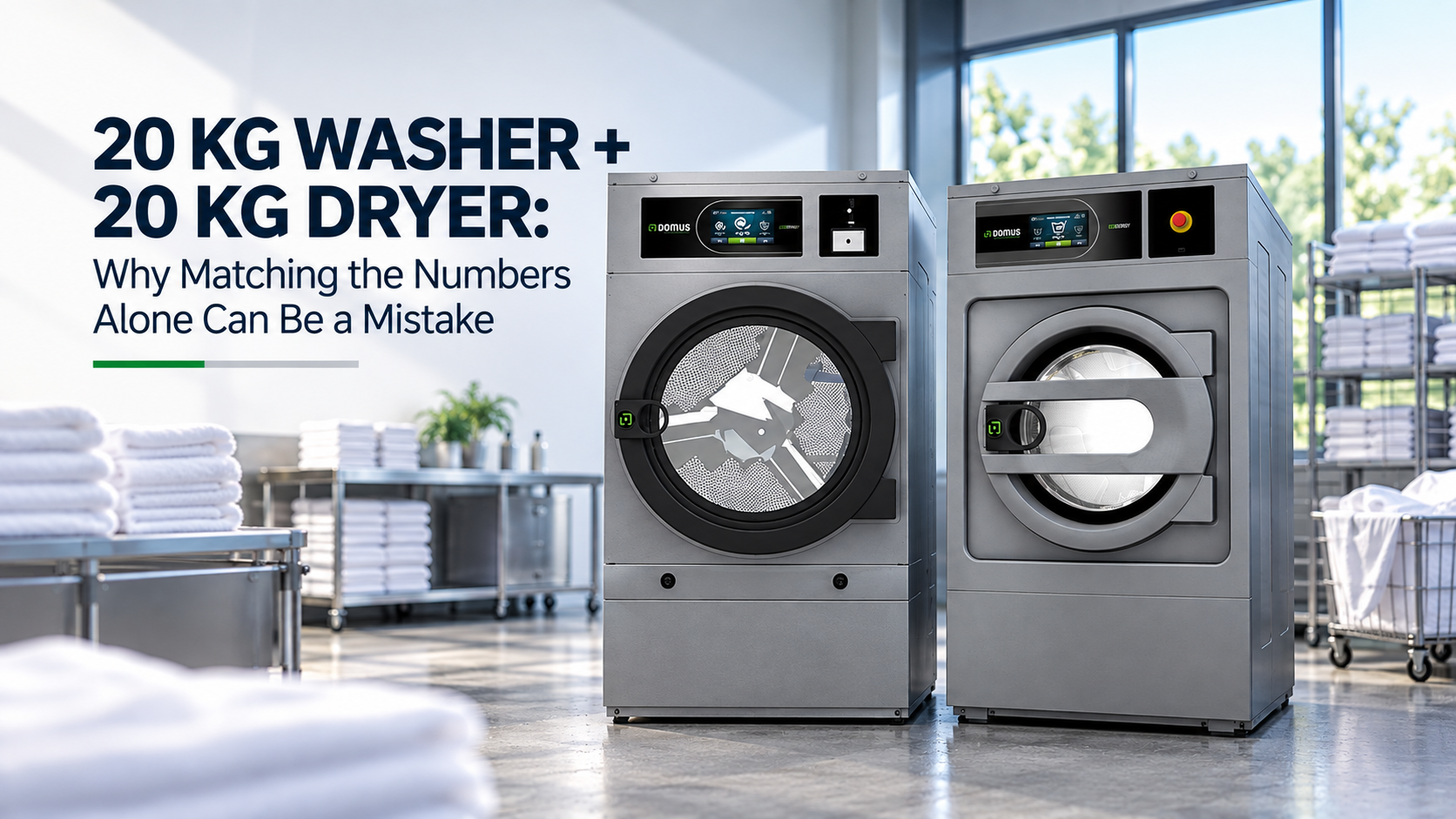
You have selected a 20 KG commercial washer, so buying a 20 KG dryer sounds like the obvious next step. But matching the KG numbers on a commercial washing machine and a tumble dryer does not automatically create a balanced laundry setup. Textile type, residual moisture, practical batch size, cycle time and daily workflow all affect how much drying capacity your business actually needs.
Does a 20 KG Washer Always Need a 20 KG Tumble Dryer?
Not necessarily.
A 20 KG washer and a 20 KG commercial tumble dryer machine may look perfectly matched on paper because both carry the same capacity figure. However, those numbers should not be treated as proof that both machines will process laundry at exactly the same rate throughout the day.
The washer processes laundry according to its wash program, while the dryer handles the moisture remaining after extraction. Their cycle times and practical loading requirements can therefore be different.
For example, consider a laundry where the washer completes several loads efficiently but the dryer takes longer to process certain heavy textiles. Wet loads may begin waiting even though the washer and dryer have the same rated KG capacity.
The real question is not:
Washer KG = Dryer KG?
It is:
Can the drying section handle the actual output coming from the washing section within the available operating hours?
This is why washer dryer capacity should be planned around the complete workflow rather than simply matching numbers from equipment specifications.
Why Can Washer and Tumble Dryer Capacity Work Differently in Real Operations?
Rated capacity is important, but it is only one part of laundry equipment capacity planning.
Several operational factors can change how your washer and dryer work together.
Textile type
Twenty kilograms of towels can behave differently during drying than a load containing lighter textiles.
Different materials retain different amounts of moisture and may require different drying programs. This means two loads with similar dry weights may not create identical drying requirements.
Practical loading
A machine's rated capacity should not automatically be treated as the correct load for every textile and program.
The practical batch size depends on the machine specifications, textile type, program and required process.
Cycle duration
Your washing and drying cycles may not take the same amount of time.
Suppose your washing section produces wet loads faster than the industrial tumble dryer machine can complete them. After several cycles, a queue can develop even if the machines have similar rated capacities.
Residual moisture
The amount of moisture remaining after extraction directly affects what the drying section has to handle.
A load leaving a washer extractor with more retained moisture may require more drying than the same type of load leaving another process with less residual moisture.
Percentage of laundry requiring tumble drying
Not everything processed through a washer necessarily follows the same drying route.
Some textiles may go to tumble drying, while others may follow different finishing processes. Therefore, total washing KG and total tumble-drying KG may not always be identical.
A better planning sequence is:
Daily Laundry KG → Textile Mix → Washing Loads → Extraction → Drying Requirement → Finishing
How Does Washer Extraction Affect the Tumble Dryer Capacity You Need?
Extraction is one of the most important connections between washing and drying.
After the wash cycle, an industrial washer extractor machine uses high-speed extraction to remove water from the textiles. The amount of water remaining influences the downstream drying requirement.
The relationship can be expressed simply as:
Higher Extraction → Less Residual Moisture → Potentially Lower Drying Requirement
However, this is a relationship rather than a guaranteed result.
Actual performance depends on the specific machine, G-factor, wash and extraction program, textile type, loading conditions and other operating factors.
This is why buyers should not compare a commercial washer and dryer using KG capacity alone.
When evaluating a washer, check its extraction performance. When evaluating the dryer, consider the condition of the laundry entering it.
This becomes especially important for laundries processing high volumes of towels, hotel linen or other items requiring significant drying.
Better extraction may reduce the work required downstream, while inadequate extraction can place more pressure on the laundry tumble dryer.
Therefore, washing and drying equipment should be evaluated as connected production stages—not two independent purchases.
What Happens When Your Tumble Dryer Is Too Small for Washing Output?
An undersized drying section may not become obvious during the first few loads of the day.
The problem appears as production continues.
The washer finishes another load, but the dryer is still occupied. The wet load waits. Then another washing cycle finishes, creating another queue.
Soon, the operation has plenty of washing capacity but insufficient practical drying throughput.
Common warning signs include:
-
Wet loads regularly waiting for dryer availability
-
Drying continuing after washing has finished
-
Longer overall turnaround times
-
Extended operating shifts
-
Difficulty handling peak-day volume
-
Operators waiting to transfer loads
-
New laundry contracts putting immediate pressure on drying
-
Washer capacity remaining unused because the drying section cannot keep up
At this point, buying another washer would not solve the main problem.
Your practical laundry processing capacity is affected by the stage restricting the overall production flow.
Think of it as:
Washing → Extraction → Drying → Finishing
If drying is consistently the slowest stage, increasing washing capacity may simply increase the amount of wet laundry waiting.
This is why a tumble dryer for laundry business should be selected according to expected drying demand, not merely because its KG rating matches the washer.
How Should You Match Washer and Tumble Dryer Capacity Before Buying?
Before purchasing commercial laundry equipment, calculate what each stage actually needs to process.
Start with daily laundry volume. Then identify how much of that volume requires tumble drying.
A useful starting point is:
Required Dryer Loads Per Day = Daily Volume Requiring Tumble Drying ÷ Practical Average Dryer Load
For example, if 300 KG per day requires tumble drying and your practical average dryer load is 20 KG:
300 ÷ 20 = 15 dryer loads per day
This is an illustrative calculation, not a capacity recommendation.
Next, determine whether those loads can be completed during your available operating window.
Your dryer capacity calculation should consider:
-
Daily KG requiring tumble drying
-
Textile mix
-
Practical dryer load size
-
Washer extraction performance
-
Residual moisture
-
Drying program requirements
-
Practical drying cycle times
-
Available operating hours
-
Peak-period volume
-
Expected business growth
You should also consider how the machines interact.
If washing consistently produces loads faster than drying can process them, additional dryer throughput may be needed. If the dryer regularly waits for washed loads, the issue may be elsewhere.
The objective is therefore:
Required Washing Throughput ≈ Required Downstream Drying Throughput
This does not mean the washer and dryer must have identical KG ratings. It means their practical output should work together efficiently for your actual laundry mix and operating schedule.
How Orgaearth Can Help
Selecting the right commercial dryer machine requires more than matching its KG number with your washer.
Orgaearth can help commercial laundry businesses evaluate daily processing volume, textile mix, washer capacity, extraction requirements, practical drying demand, available operating hours, utilities and future volume before selecting suitable equipment.
Whether you are planning a new laundry business setup or trying to correct an existing washer-dryer capacity mismatch, the goal is to build a balanced process where washing, drying, and finishing can support the required daily throughput.
Frequently Asked Questions
Does a 20 KG washer need a 20 KG tumble dryer?
Not automatically. Similar rated capacities do not guarantee similar practical throughput. Textile type, extraction performance, residual moisture, loading and cycle duration should also be considered.
How do I calculate tumble dryer capacity for a commercial laundry?
Start with the daily KG that actually requires tumble drying, divide it by the practical average dryer load, and check whether the required number of cycles can be completed within available operating hours.
Should dryer capacity be bigger than washer capacity?
There is no universal ratio suitable for every laundry. The correct relationship depends on textile mix, extraction performance, drying cycles, operating hours and how much washed laundry requires tumble drying.
Why is my industrial laundry dryer becoming a bottleneck?
Possible reasons include insufficient practical drying capacity, long drying cycles, high residual moisture, unsuitable load planning or washing output exceeding downstream drying throughput.
What should I check before buying a commercial tumble dryer?
Evaluate practical capacity, textile mix, daily drying KG, cycle requirements, available utilities, operating hours, washer extraction performance, site requirements and expected future volume.
Contact Us
Orgaearth Laundry Solutions
Plot no. 774, Udyog Vihar, Phase 5, Gurugram, Haryana, India-122016
Email: marketing@orgaearth.com
Contact No.- +91 7042912777
Categorieën
Meer lezen
Buy Old Gmail Accounts Buy Are you exploring the digital landscape for a strategic advantage? If so, consider the potential of old Gmail accounts. They may seem like relics from a bygone era, yet they offer unique benefits that modern accounts simply can’t match. As businesses strive to build trust and credibility online, many are turning to these aged accounts as an essential tool in...

Field Notes · Materials & Craft The Feel of Real Materials: A Week With the tangma2088 Collection By the tangma2088 editorial team · September 1, 2026 · ~9 min read This is a hands-on report on seven pieces from the tangma2088 and qiqiyg collections — a suede weekender, two leather sneakers, two canvas shoulder bags, a cap-toe oxford and a winter parka. No studio...

The vitality of the Geofencing Market hinges on the continuous development of robust and innovative solutions that not only create virtual boundaries but also provide precise location intelligence, automate processes, and enhance user experiences. An effective geofencing market solution is a comprehensive offering, encompassing advanced location technologies, intelligent software platforms, and...

When traveling for work, finding the right place to stay is essential for both productivity and peace of mind. Choosing a Business hotel in Jerusalem can significantly enhance your experience by combining convenience, comfort, and professional amenities. Whether you’re attending meetings, conferences, or managing remote tasks, Paamonim Hotel Jerusalem stands out as a destination designed...

Liquid rhinoplasty is a non-surgical cosmetic procedure that uses dermal fillers to reshape and refine the nose, offering immediate aesthetic improvements without surgery or downtime. It has become increasingly popular among individuals seeking subtle facial enhancement, particularly those exploring Liquid Rhinoplasty Riyadh as a quick and minimally invasive way to improve nasal...