


Fire Survival Cables in India | Reliable Fire Resistant Cables | IMT Cables
Introduction
When a fire breaks out inside an industrial facility, a commercial building, or critical infrastructure, the electrical systems that keep emergency equipment running are often the difference between an incident that is contained and one that escalates. This is where Fire Survival Cables play a vital role. Unlike standard electrical cables, fire survival cables are designed to maintain circuit integrity even when exposed to direct flame and high temperatures, helping ensure that essential systems such as alarms, emergency lighting, and safety equipment continue to function during a fire event. For industries, infrastructure projects, and facilities where uninterrupted electrical performance during emergencies is non-negotiable, choosing the right fire-resistant cable solution is a critical engineering decision.
At IMT Cables, we understand that reliability under pressure is not optional — it is the entire point of a fire survival cable. This page explains what fire survival cables are, why they matter, where they are used, and what industrial buyers and project teams should look for when selecting one.
What Are Fire Survival Cables?
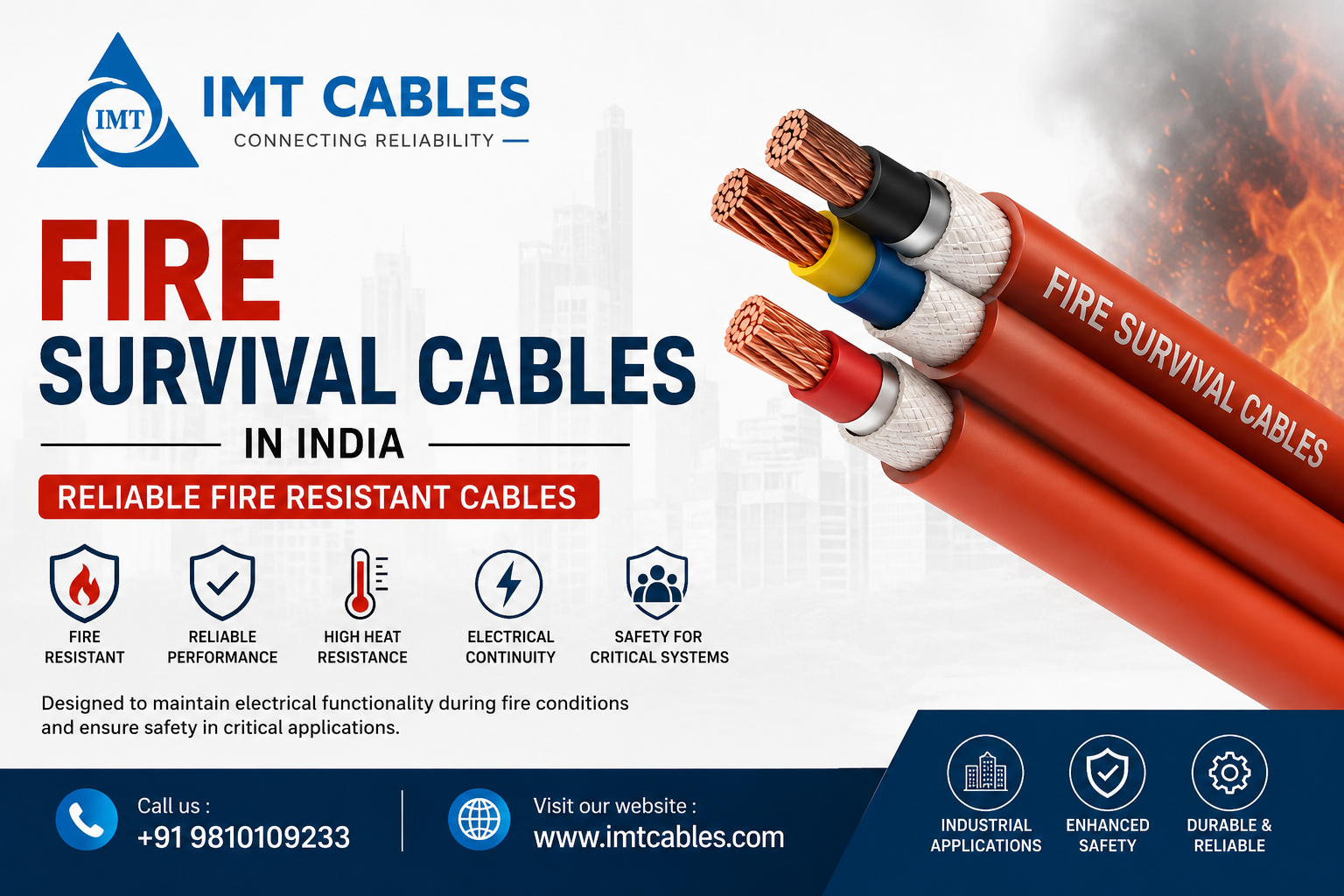
A Fire Survival Cable is a type of cable engineered to continue conducting electricity for a defined period even while burning or while directly exposed to fire. This is fundamentally different from a standard power or control cable, which is only expected to perform under normal operating conditions and is not designed to maintain function once its insulation is compromised by heat or flame.
The distinguishing characteristic of a fire survival cable lies in its construction — the combination of conductor design, insulation materials, and protective layering is intended to resist the effects of fire long enough for critical systems to keep operating during an emergency, rather than failing at the first sign of heat exposure. This makes fire survival cables fundamentally different in purpose from ordinary electrical cables: conventional cables are built for everyday electrical transmission, while fire survival cables are built with continuity of function during fire conditions as a core design consideration.
Because of this role, fire survival cables are typically specified in applications where a loss of electrical supply during a fire could compromise safety, evacuation, or emergency response — rather than in general-purpose wiring applications.
Key Features of Fire Survival Cables
While exact construction and specifications vary by application and project requirement, fire survival cables are generally associated with the following characteristics:
-
Fire resistance – Constructed to withstand exposure to flame and elevated temperatures without immediate circuit failure.
-
Reliable electrical continuity during fire conditions – Designed with the objective of keeping connected systems powered for as long as possible during a fire event.
-
Heat resistance – Insulation and sheathing materials selected to perform under high-temperature stress.
-
Durability – Built to withstand demanding installation and operating environments, not just fire exposure.
-
Safety-focused construction – Engineered with the safety of occupants, equipment, and emergency responders as a primary design consideration.
-
Reliable performance in critical applications – Suited to systems where failure is not an acceptable outcome.
-
Suitability for demanding industrial environments – Capable of performing in industrial settings that combine electrical, thermal, and mechanical stress.
For any project, the exact fire-performance rating, construction, and technical parameters of a fire survival cable should always be confirmed directly with IMT Cables based on the specific application and applicable standards.
Why Are Fire Survival Cables Important?
In a fire emergency, several systems must continue operating for as long as possible — fire alarms need to keep signaling, emergency lighting needs to stay illuminated to guide evacuation, and safety systems such as smoke extraction or emergency communication need continuous power. If the cabling feeding these systems fails early in a fire event, the systems they support fail with them, at precisely the moment they are needed most.
Fire survival cables address this gap. By maintaining electrical continuity under fire conditions, they support the broader safety infrastructure of a building or facility, giving occupants more time to evacuate safely and giving emergency responders a better chance of managing the situation effectively. This is why fire survival cables are frequently specified in life-safety and critical infrastructure applications, rather than treated as a standard electrical component.
Applications of Fire Survival Cables
Fire-resistant and fire survival cable solutions are commonly required across a range of industries and project types where electrical continuity during a fire is a safety priority, including:
-
Emergency systems and emergency power circuits
-
Fire alarm and fire detection systems
-
Safety and emergency equipment installations
-
Industrial facilities and manufacturing plants
-
Infrastructure and construction projects
-
Power and electrical installations
-
Transportation and railway-related applications
-
Other critical electrical systems where continuity of supply during a fire event is essential
Specific application requirements vary from project to project, and the suitability of a fire survival cable for a particular use case should always be confirmed with IMT Cables based on the technical and regulatory requirements of that project.
Advantages of Fire Survival Cables
From a buyer's or project engineer's perspective, specifying fire survival cables offers several practical benefits:
-
Improved fire safety – Supports the broader fire safety strategy of a building or facility.
-
Reliable performance – Engineered specifically to perform under fire conditions rather than general-purpose use.
-
Protection of critical electrical circuits – Helps safeguard the circuits that life-safety systems depend on.
-
Reduced risk of electrical interruption – Lowers the likelihood of a sudden loss of power to essential systems during an emergency.
-
Durability in demanding environments – Built to handle the combined thermal, mechanical, and electrical stresses common in industrial and infrastructure settings.
-
Suitability for critical infrastructure – A practical fit for facilities where downtime or system failure carries significant safety or operational consequences.
Fire Survival Cables for Industrial Applications
Industrial environments present a unique combination of challenges — high electrical loads, mechanical stress, exposure to heat, and in many cases, tightly regulated safety requirements. In these settings, a cable failure is rarely just an inconvenience; it can directly affect plant safety, equipment protection, and personnel evacuation procedures.
This is where fire survival cables contribute meaningfully to overall electrical safety. By maintaining functionality even as fire conditions develop, they help ensure that critical monitoring, alarm, and safety systems within an industrial facility remain operational for longer, supporting a more controlled and predictable emergency response. For facilities handling hazardous processes, heavy machinery, or continuous operations, incorporating reliable fire-resistant cabling into the electrical design is an important part of a broader risk-management approach.
How to Choose the Right Fire Survival Cable?
Selecting the correct fire survival cable is a technical decision that depends on the specifics of the application. Project teams and procurement professionals should evaluate the following before finalizing a cable specification:
-
Application requirements – What system is the cable powering, and what is its role during a fire event?
-
Operating environment – Indoor, outdoor, industrial, underground, or otherwise demanding conditions.
-
Temperature conditions – Both normal operating temperature and the expected temperature profile during a fire event.
-
Voltage requirements – The voltage rating needed for the specific circuit or system.
-
Number of cores – Single-core or multi-core configuration based on the electrical design.
-
Cable size – Conductor size appropriate to the load and length of run.
-
Installation conditions – Cable routing, containment method, and any mechanical protection required.
-
Required fire-performance characteristics – The level and duration of fire resistance needed for the application.
-
Applicable standards/specifications – Relevant Indian and international standards that apply to the project.
-
Project-specific requirements – Any additional technical, regulatory, or client-specified conditions.
Because fire survival cable requirements can vary significantly between projects, we recommend that customers consult directly with IMT Cables to confirm the right specification for their specific application, rather than relying on generic assumptions.
Why Choose IMT Cables for Fire Survival Cables?
IMT Cables, the flagship company of the RAS Group, brings decades of family-driven experience in cable manufacturing to every product line, including fire survival cables. A few reasons industrial buyers and project teams work with us:
-
Long-standing experience in cable manufacturing – Our leadership brings experience spanning several decades in the cable industry.
-
Modern manufacturing facilities – Our production line is equipped with contemporary machinery and a well-defined manufacturing process designed for consistency and precision.
-
In-house testing laboratory – We maintain a fully equipped testing facility with modern instruments, managed by trained and experienced staff, to support our quality control processes.
-
Technical expertise – Our team works closely with clients to understand application-specific requirements before finalizing a cable solution.
-
Quality-focused production – Our manufacturing approach is built around consistent quality control at every stage of production.
-
Capability to develop customized cable solutions – We can manufacture cables to meet client specifications and align with various applicable international standards.
-
Experience serving demanding industrial sectors – Our product range spans multiple industrial and specialized applications, reflecting broad manufacturing experience across sectors.
When you choose IMT Cables for your fire survival cable requirements, you are working with a manufacturer that treats technical accuracy and quality control as central to how we operate — not as an afterthought.
Fire Survival Cables in India
The demand for reliable Fire Survival Cables in India continues to grow as industrial facilities, infrastructure projects, and commercial developments place greater emphasis on fire safety and regulatory compliance. For project teams sourcing Fire Resistant Cables India–wide, a few factors deserve particular attention:
Quality and manufacturing consistency. Fire survival cables are only as reliable as the manufacturing process behind them. Consistent quality control across production batches is essential for a product where performance under fire conditions is the entire value proposition.
Application-specific selection. India's industrial and infrastructure landscape is diverse — from manufacturing plants and railways to commercial buildings and power installations — and each application brings its own technical requirements. A cable suited to one project may not be the right fit for another.
Testing and verification. Given the safety-critical nature of fire survival cables, working with a manufacturer that maintains proper testing capabilities and quality assurance processes is important for project confidence.
Relevant standards. Projects in India often need to align with specific Indian and, where applicable, international standards. Confirming which standards apply to your project — and working with a manufacturer capable of meeting them — is a key part of the sourcing process.
IMT Cables works with industrial buyers and project teams across India to help identify the right fire survival cable solution for their specific requirements, backed by our manufacturing experience and in-house testing capabilities.
Fire Survival Cables: Quality, Testing & Reliability
For a product category where the entire purpose is to perform reliably under fire conditions, testing and quality assurance are not optional extras — they are fundamental to the product's value. A fire survival cable that has not been through a rigorous quality control process offers no real assurance to the systems and people that depend on it.
At IMT Cables, our approach to quality is supported by our in-house testing laboratory, which is equipped with modern testing instruments and operated by trained, experienced staff. This allows us to apply consistent quality checks throughout the manufacturing process, from raw material inputs to finished product. Combined with our well-defined production line and modern machinery, this testing infrastructure supports our broader commitment to manufacturing cables that industrial buyers and project teams can rely on.
We do not publish or claim specific test results, certifications, or standards compliance beyond what can be verified and confirmed for a given product and project. Customers with specific testing, certification, or standards requirements for their fire survival cable application are encouraged to discuss these directly with our technical team.
Fire Survival Cables: What Industries Should Know Before Choosing a Cable
Selecting the right Fire Survival Cables for a project involves more than picking a product off a catalog page. Here are some practical considerations that industrial buyers, procurement teams, and project engineers should keep in mind:
Start with the application, not the product. Before evaluating specific cable options, clearly define what system the cable will power and what role that system plays during a fire event. A cable feeding an emergency lighting circuit may have different requirements than one feeding a fire alarm control panel.
Understand the installation environment. Factors like ambient temperature, exposure to moisture or chemicals, mechanical stress, and installation method (tray, conduit, direct burial, etc.) all influence which cable construction is appropriate.
Clarify fire-performance requirements early. Different projects and regulatory contexts may call for different levels and durations of fire resistance. This should be established early in the design phase, not after materials have already been ordered.
Review cable construction details. Conductor material, insulation type, sheathing, and any additional protective layers all contribute to how a cable performs — both under normal conditions and during a fire event.
Confirm applicable standards. Depending on the project, sector, and location, specific Indian or international standards may apply. Confirming these requirements upfront helps avoid costly changes later in the project.
Account for project-specific requirements. Every project has its own combination of technical, regulatory, and client-driven requirements. A cable solution that worked well for one project should not be assumed to automatically suit another.
Approaching fire survival cable selection with this level of diligence helps ensure that the final choice genuinely supports the safety objectives it is meant to serve — rather than being a generic, one-size-fits-all decision.
Frequently Asked Questions (FAQ)
1. What are Fire Survival Cables?
Fire Survival Cables are cables engineered to maintain electrical continuity even when exposed to fire, helping keep critical systems such as alarms and emergency lighting operational during a fire event.
2. What is the difference between Fire Survival Cables and ordinary electrical cables?
Ordinary electrical cables are designed for standard electrical performance under normal operating conditions. Fire survival cables are specifically constructed to continue functioning during fire exposure, which is not a design requirement for conventional cables.
3. Where are Fire Survival Cables used?
They are commonly used in emergency systems, fire alarm systems, safety and emergency equipment, industrial facilities, infrastructure projects, power installations, and transportation-related applications where continuity during fire conditions is important.
4. Why are Fire Survival Cables important for critical electrical systems?
Because they help ensure that essential safety systems remain powered during a fire, giving occupants more time to evacuate and supporting a more effective emergency response.
5. Are Fire Survival Cables suitable for industrial applications?
Yes, fire survival cables are widely used in industrial settings where reliable electrical continuity during emergencies is important for both safety and operational risk management.
6. How do I choose the right Fire Survival Cable?
Selection depends on factors such as application requirements, operating environment, temperature conditions, voltage, number of cores, cable size, installation conditions, and applicable standards. Consulting with a manufacturer like IMT Cables helps ensure the right fit for your project.
7. What factors should be considered when selecting Fire Resistant Cables in India?
Buyers should consider manufacturing quality and consistency, application-specific requirements, testing and verification processes, and the relevant Indian or international standards that apply to their project.
8. Can Fire Survival Cables be customized for specific applications?
Yes, IMT Cables offers customized cable solutions developed according to client specifications and applicable standards. Specific requirements should be discussed directly with our technical team.
9. What standards should be considered for Fire Survival Cables?
Applicable standards vary depending on the project, sector, and regulatory requirements. IMT Cables works with clients to manufacture cables in line with relevant Indian and international standards where applicable — please contact us to confirm requirements for your specific project.
10. How can I contact IMT Cables for Fire Survival Cable requirements?
You can reach the IMT Cables team using the contact details provided in the Contact Us section below to discuss your project requirements, technical specifications, and customization needs.
Contact Us
Looking for dependable Fire Survival Cables for your project, facility, or infrastructure development? The team at IMT Cables is ready to help you identify the right fire-resistant cable solution based on your specific application, technical requirements, and applicable standards.
Contact IMT Cables to discuss your Fire Survival Cable requirements.
-
Email: info@imtcables.com
-
Phone: +91 9810109233
-
Address: A-96, Mayapuri Industrial Area, Phase-II, New Delhi – 110064, India
Whether you need product information, technical assistance, or a customized fire survival cable solution for a specific project, our team is available to guide you through the selection process and support your requirements from specification through delivery.
Categorieën
Read More
Few Ranger builds capture the fantasy of a powerful archer quite like Ice Shot Deadeye. Combining explosive clear speed, beautiful visual effects, and impressive scaling potential, this build remains a favorite among Path of Exile players. Access to sufficient Path of exile currency can significantly enhance the build's progression by enabling faster acquisition of key equipment upgrades. Ice...
Buy Old Gmail Accounts Buy Are you exploring the digital landscape for a strategic advantage? If so, consider the potential of old Gmail accounts. They may seem like relics from a bygone era, yet they offer unique benefits that modern accounts simply can’t match. As businesses strive to build trust and credibility online, many are turning to these aged accounts as an essential tool in...

🚀 🚀If you want more information just contact me now. 24/7 Hours Reply/Contact ➽ ➽ ➽Telegram : @usakyclite ➜➜➜ WhatsApp : +1 (719) 480-6771 ⟹ ⟹ ⟹Email : usakyclite@gmail.com...

Looking to Buy Old GitHub Accounts for your development projects or business needs? GetPVATop.com offers high-quality aged GitHub accounts that are carefully checked and ready for legitimate professional use. Whether you’re a software developer, development agency, startup, or technology company, our old GitHub accounts provide a convenient solution for managing...