


The Investor's Guide to Single Tenant Net Lease Properties
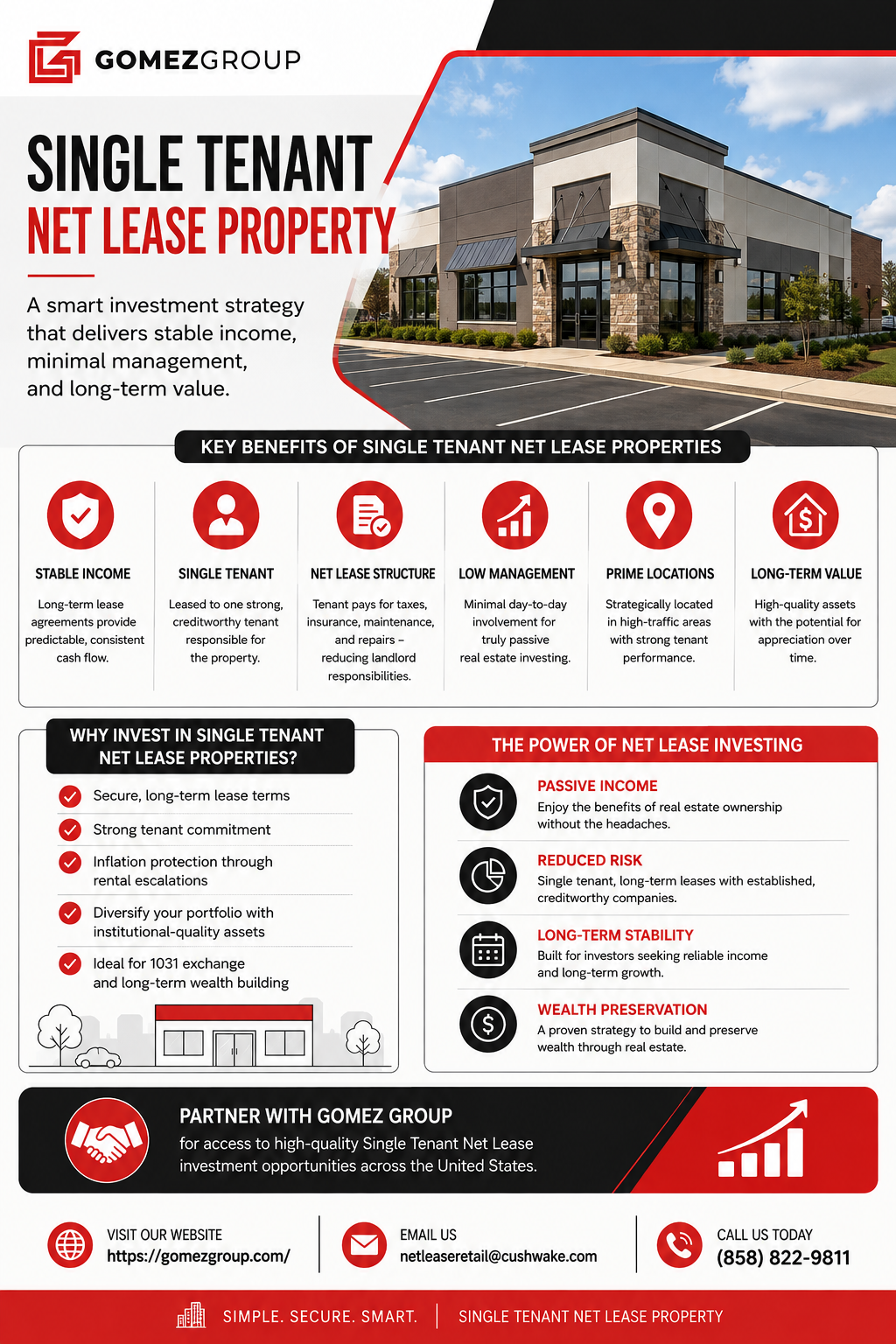
For investors who want real estate income without the headaches of active management, few asset types offer the same combination of simplicity and stability as a standalone commercial building leased to one occupant. These assets have quietly become one of the most in-demand categories in commercial real estate and understanding how they work is the first step toward deciding if they belong in your portfolio.
This guide walks through what these investments actually are, why they've become so popular, what to look for before buying one, and the questions most first-time buyers ask before writing an offer.
What Are We Actually Talking About?
At its simplest, this is a freestanding commercial building occupied by a single business a coffee shop, pharmacy, bank branch, or quick-service restaurant, for example under a long-term lease where the tenant covers most or all of the property's operating expenses: taxes, insurance, and maintenance.
Because the tenant handles these responsibilities, the owner's role is largely limited to collecting rent and monitoring the lease. That's the core appeal: real estate ownership without the phone calls about broken HVAC units or leaking roofs.
You'll often see this structure referred to using a few overlapping terms a corporate-backed lease investment, an absolute net lease deal, a credit tenant asset, or simply a triple net (NNN) property. They're all describing variations of the same basic idea: one tenant, one building, a lease that shifts most operating costs off the owner's plate.
Why This Asset Class Has Become So Popular
1. Predictable, Long-Term Income
Leases on these properties commonly run 10, 15, or even 20 years, often with built-in rent escalations every few years. For an investor prioritizing steady cash flow over active involvement, that kind of predictability is hard to match with most other real estate types.
2. Reduced Landlord Responsibility
Since the tenant is contractually responsible for the bulk of operating expenses, owners avoid the unpredictable maintenance costs that come with multi-tenant retail or office buildings. This is a major reason these deals appeal to out-of-state investors, retirees, and anyone who wants real estate exposure without a second job managing it.
3. Tenant Credit Quality
A large share of these properties are leased to well-known national brands — companies with established financials and long operating histories. Buying a building occupied by a recognizable, financially stable operator generally lowers the perceived risk compared to leasing to an unproven local business.
4. A Natural Fit for 1031 Exchanges
Investors selling an appreciated property and looking to defer capital gains taxes often roll proceeds into this type of asset specifically because of its passive structure and straightforward due diligence process it's one of the more common landing spots for exchange capital in today's market.
5. Portfolio Diversification
Adding a freestanding retail or restaurant property alongside office, industrial, or multifamily holdings spreads risk across different tenant categories and lease structures, which can help smooth out returns when one sector underperforms.
What to Evaluate Before You Buy
Not every deal in this category is created equal. A few factors separate a strong purchase from a mediocre one:
Location and traffic counts. Visibility, accessibility, and traffic volume matter enormously for retail and restaurant tenants. A well-located building on a high-traffic corridor tends to hold its value and its tenant far better than one tucked away from visibility.
Remaining lease term. A property with 15 years left on the lease carries very different risk than one with 2 years remaining. Shorter terms mean more uncertainty about what happens at renewal, and lenders often price that uncertainty into financing terms.
Rent escalation structure. Does rent increase annually, every five years, or not at all? Fixed, scheduled increases help protect purchasing power over a long hold period.
Tenant financial strength. A lease is only as good as the company standing behind it. Corporate-guaranteed leases from established operators generally carry lower risk than franchisee-guaranteed agreements.
Market fundamentals. Population growth, household income, and local employment trends all influence how a property performs over the life of the lease and how easily it could be re-leased if the tenant were ever to leave.
Physical condition. Even with a tenant covering maintenance under the lease, a pre-purchase inspection helps surface any deferred maintenance or structural issues that could become a negotiating point.
Who Tends to Buy These Properties
This category attracts a fairly wide range of buyers:
- Individual investors seeking passive income
- 1031 exchange buyers moving out of management-intensive assets
- Retirees looking to simplify their holdings
- Family offices and private investment groups
- First-time commercial real estate buyers who want a more approachable entry point than a large multi-tenant asset
The common thread is a preference for predictable income over hands-on involvement.
A Real-World Example Worth Studying
Coffee and quick-service retail brands are a good illustration of why this category has grown so popular. National coffeehouse chains, for instance, tend to sign long-term leases, maintain strong same-store sales performance, and hold appeal across a wide range of markets — suburban, urban, and everything in between. A listed single tenant Starbucks property is a useful example of what this structure looks like in practice: an established brand, a long-term lease, and minimal landlord involvement, all wrapped into one transaction.
How Gomez Group Approaches These Investments
Finding the right opportunity in this space takes more than scrolling listings it requires a clear read on lease quality, tenant strength, and local market conditions. Gomez Group works with investors across the country to evaluate net lease opportunities, from single-tenant retail and restaurant assets to larger shopping center portfolios, matching properties to each buyer's specific goals around income, risk tolerance, and hold period.
Whether you're placing 1031 exchange proceeds, building a retirement-focused income stream, or simply adding your first net lease property to a growing portfolio, Gomez Group's experience across the net lease sector can help you avoid common pitfalls and move forward with confidence.
Frequently Asked Questions
What does "single tenant net lease" actually mean?
It refers to a freestanding commercial property occupied by one business, under a lease where the tenant is responsible for most or all property expenses typically taxes, insurance, and maintenance — rather than the landlord.
How is this different from a triple net (NNN) lease?
They're closely related terms. "Triple net" describes the expense structure of the lease itself (tenant pays taxes, insurance, and maintenance), while "single tenant" simply means the building has one occupant rather than multiple tenants sharing the space. Most single-tenant retail and restaurant properties use a triple net structure.
Is this a good option for a first-time commercial real estate investor?
Often, yes. The passive management structure and straightforward lease terms make this category more approachable than multi-tenant retail or office buildings, which require more active oversight.
What happens if the tenant leaves or the lease isn't renewed?
This is one of the biggest risk factors to evaluate upfront. A strong location with good visibility and traffic counts is typically easier to re-lease or repurpose, which is why location analysis matters even when a tenant looks financially secure today.
How much capital is typically needed to get started?
It varies widely by market, tenant, and building size — smaller assets can be accessible to individual investors, while larger or higher-profile properties attract institutional capital. Working with an experienced brokerage helps match your available capital to realistic opportunities.
Can financing be arranged for these purchases?
Yes. Lenders are often comfortable financing these deals, particularly when the tenant carries strong credit and the lease has a healthy amount of term remaining, since the income stream is easier to underwrite than more speculative property types.
Final Thoughts
A freestanding, single-occupant commercial property with a long-term lease offers a genuinely different ownership experience than most other real estate investments less day-to-day involvement, more predictable income, and a more straightforward due diligence process. The trade-off is that success depends heavily on getting the fundamentals right: location, lease terms, and tenant strength.
If you're exploring this category and want to see what a well-structured opportunity looks like, Gomez Group's current Starbucks property listing offers a real example of the kind of asset investors in this space are targeting. For guidance tailored to your own investment goals, connecting with a team that specializes in net lease transactions is one of the most effective ways to move forward with clarity.
Categorieën
Read More
Brain and nervous system health plays an important role in maintaining overall well-being and quality of life. Neurological conditions can affect movement, memory, communication, and daily activities, making timely diagnosis and proper treatment essential. Choosing the right healthcare facility ensures patients receive expert guidance, advanced care, and continuous support throughout their...

At the stroke of midnight on December 31, 2025, as the world counted down to New Year’s Eve 2026, millions tuned in to watch the live broadcast from Times Square. Hosted by television personality Andy Cohen, the show blended celebration, entertainment, and of course, fashion. What grabbed almost as much attention as the countdown itself was Cohen’s bold metallic blue puffer jacket...

Buy Naver Accounts In the digital age, where online presence dictates success, having a robust platform to connect with users is essential. For those seeking to tap into the vibrant South Korean market, Buy Naver accounts can be a game-changer. As one of Korea’s leading search engines and social platforms, Naver offers unparalleled access to millions of active users. But what makes it so...

The Parke Sweatshirt has become one of the most talked-about wardrobe essentials across the United States. Whether you are dressing for a casual outing, relaxing at home, or layering for cooler weather, many people choose a park sweatshirt because it combines comfort with timeless style. Instead of following short-lived fashion trends, Parke focuses on creating clothing that people can wear...

Streetwear trends come and go, but some fashion pieces manage to become permanent icons. The Essentials Fear of God hoodie is one of them. From TikTok creators and athletes to celebrities and everyday fashion lovers, this hoodie has completely taken over modern wardrobes — and honestly, it’s not difficult to see why. Minimal yet luxurious, oversized yet effortlessly wearable, the...